
DANU Ceramics: Ontdek het merk

"Danu was the ancient Celtic goddess of the earth and creativity and the Hindu goddess of water – three fundamental elements for the creation of ceramics. It is believed that the two goddesses share the same origin, dating back to the period when the Vedic peoples of South Asia traded and interacted with the Celts of Western Europe. Many waterways in Europe and Asia were named in honour of Danu, such as the Danube River in Germany and the Danu River in Nepal. The ancient peoples of Western Europe and South Asia considered themselves the children of Danu. In Ireland, they were called the Tuatha Dé Danann (the people/tribe of the goddess Danu)."

This is Ruth, the founder and creator of DANU Ceramics.
Ruth graduated from the National College of Art and Design in Dublin in 2011 and founded DANU in 2015. She is originally from Dublin, Ireland, where she has always lived. Every piece is designed and made by her using a wide range of techniques, such as hand-building, glass fusing, and slab work. Ruth loves experimenting with different clays, glazes, and materials, such as 22k gold, mother-of-pearl, and glass. Every piece she creates is unique and never identical to another.
Recently, she started collecting and selling extraordinary works made by other artisans from around the world, such as gold and lapis lazuli jewellery from Afghanistan, agate from Brazil, glass beads from Ghana and Ethiopia, and incredible ornaments created by refugees (a United Nations initiative).
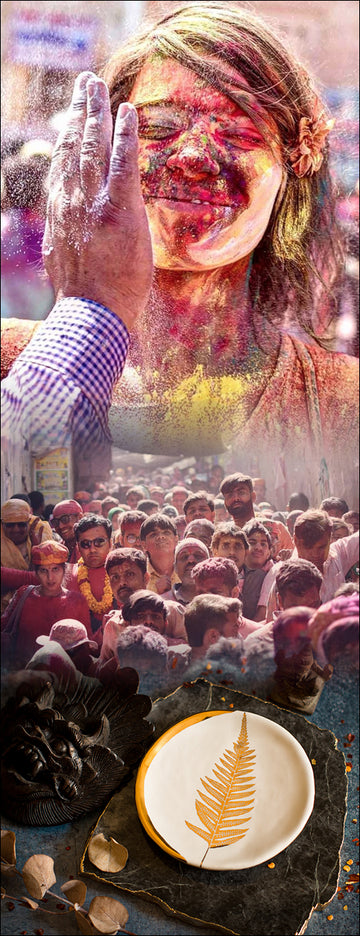
Her inspiration comes from travel, nature, and her homeland, Ireland. Ruth and her partner spend a lot of time curating every single photo. Whenever they travel, they collect beautiful and unusual objects from local artisans to use in their photographs: copper spoons from Lhasa, Tibet, ceramics from Takayama, Japan, brass objects and textiles from Varanasi, India, and sculptures from Flores, Indonesia. Ruth hopes that, browsing her shop, people can feel as if they are embarking on a journey. Every product has its own story to discover.

Her mission is to create pieces in small quantities, affordable and of quality, that last over time. Ruth believes that ethical craftsmanship can be easily accessible. Her pieces maintain their exclusivity not thanks to high prices, but because they are not mass-produced. The jewellery boxes are made of recycled kraft paper. She uses corrugated cardboard instead of plastic for packaging and recycled shipping boxes collected from local shops.
Ruth loves personally delivering the orders to her retailers in the centre of Dublin, stopping for a chat and meeting other designers and small business owners. Companies with a strong environmental conscience, that adopt eco-friendly practices, have fewer employees, less waste, and a lower turnover compared to large companies. Small businesses are the future and are inherently more eco-sustainable, without the greenwashing of huge corporations.

Ruth believes that objects created with clay should maintain a natural quality, that shows appreciation for the integrity of objects and natural processes, with visible traces of having been made by hand. Wabi-sabi (侘寂) is an ancient philosophy rooted in Zen Buddhism. It is a Japanese aesthetic that values the imperfect, the handcrafted, and simplicity. It evokes a rustic simplicity, freshness, or tranquility and can be applied to both natural objects and man-made objects, or to a subtle elegance. It can also refer to the peculiarities and anomalies that arise during the construction process, adding uniqueness and elegance to the object. As a former perfectionist, this quote resonates deeply with her: "To accept the world as imperfect, incomplete, and transient, and then to go deeper by celebrating this reality, is something akin to freedom." - Richard Powell, author of "Wabi Sabi Simple: Create beauty. Value imperfection. Live deeply" (2004).